
Bachelor of Agriculture
Agriculture’s focus on science and sustainability is how we will adapt to our changing climate, declining environmental health and increasing demand for safe food production to feed our growing populations.
BE IN DEMAND
A Bachelor of Agriculture is your opportunity to use science, technology and business to tackle critical sustainability issues and build a career with lasting impact.
If you’d like to understand how to harness natural processes to sustainably feed our growing population, improve natural resource management and contribute to Australia’s growing agricultural industry, the Bachelor of Agriculture is an ideal choice. Graduates with a degree in agriculture are highly sought after in Australia, with an employment rate of over 92 per cent.
You’ll learn the science necessary to produce safe, high-quality and ethical food and fibre as well as the economics underpinning Australia’s important role in international trade. Australia is a major global supplier of agricultural goods – around $40 billion of Australia’s projected $60 billion of agricultural production in 2019–20 will be exported.
LEARN IN THE LAB AND THE FIELD
An agriculture degree lets you apply biology, chemistry, physics, and economics and see the real-world results of your actions. Whether you start your post-university career in a laboratory, on farms or in a bank, you’ll be making a real impact on the world. You’ll complement your lab and classroom learning with fieldwork, and you can even choose to spend a semester learning at our agricultural research and teaching campus at Dookie, giving you additional hands-on experience and knowledge of farm operations.
APPLY THE LATEST TECHNOLOGY
Agriculture is at the beginning of a technological revolution, with research by Melbourne academics playing a leading role.
Drone-based sensors can monitor plants for disease and water stress across areas equivalent to hundreds of football fields in under an hour. ‘Big data’ and machine learning will give you tools to help farmers grow more food while reducing agriculture’s environmental impact. Study the science and economics underpinning these innovations and enter the workforce ready to contribute to sustainable and profitable agriculture.
IMPROVE CROP AND ANIMAL HEALTH
Plants and animals provide more food and fibre when we protect their health and welfare. Our academics determine the best ways to maintain the welfare of farm animals, develop diets to help livestock thrive in hot and dry conditions, discover the origin, spread and effects of disease and develop new medicines. Our scientists are using precision gene-editing tools to develop crops that can survive disease, drought and heat. Develop an understanding of plant and animal health and welfare to prepare you for a career in the agricultural industry or for further study in veterinary medicine.
MAKE OUR FOOD SUPPLY SUSTAINABLE
Farmers manage 48 per cent of Australia’s landmass, and each year, on average, an Australian farmer will feed 600 people. But in a changing climate, we need to maintain a healthy environment, too. Benefit from the knowledge and expertise of our researchers as they find ways to make farming more drought-resilient, reduce greenhouse gas emissions, improve soil health and re-use waste while producing high-quality food. You’ll learn how to monitor and optimise the transfer of nutrients from soils to plants to animals and how to make land and water use more sustainable by applying agricultural science and economics.
Pathway into the Bachelor of Agriculture
Students who complete the Diploma in General Studies pathway program will be eligible for substantial credit towards their Bachelor of Agriculture degree.
Campus Information
Parkville campus
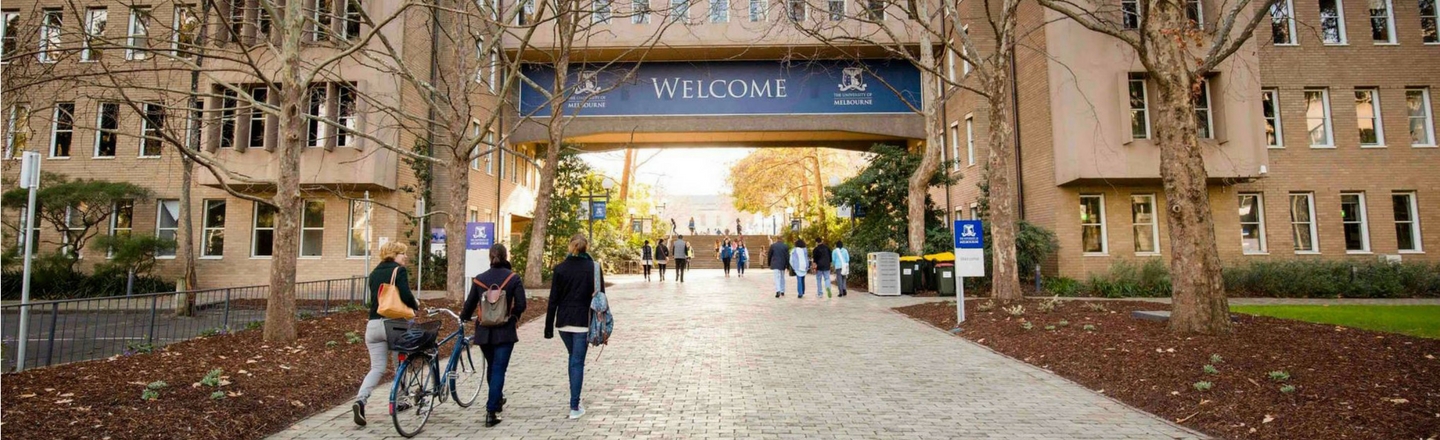
Our Parkville campus is a city within a city. With cafes, 12 libraries, gyms, specialty stores, a small supermarket, and even a seasonal farmers market, you’ll never have to leave. The Parkville campus is situated within a renowned knowledge precinct, which includes eight hospitals, many leading research institutes and a wide range of knowledge-based industries.
Intakes
- March
- July
Application Processing Time in Days: 60
Minimum English Language Requirements
| English Level Description | IELTS (1.0 -9.0) | TOEFL IBT (0-120) | TOEFL CBT (0-300) | PTE (10-90) | |
|---|---|---|---|---|---|
| Expert | 9 | 120 | 297-300 | 86-90 | |
| Very Good | 8.5 | 115-119 | 280-293 | 83-86 | |
| Very Good | 8 | 110-114 | 270-280 | 79-83 | |
| Good | 7.5 | 102-109 | 253-267 | 73-79 | |
| Good | 7 | 94-101 | 240-253 | 65-73 | |
| Competent | 6.5 | 79-93 | 213-233 | 58-65 | |
| Competent | 6 | 60-78 | 170-210 | 50-58 | |
| Modest | 5.5 | 46-59 | 133-210 | 43-50 | |
| Modest | 5 | 35-45 | 107-133 | 36-43 | |
| Limited | 4 | 32-34 | 97-103 | 30-36 | |
| Extremely Limited | < 4 | < 31 | < 93 | < 30 |
Job Opportunity Potential
Graduate study areas include:
- Agricultural sciences
- Agribusiness
- Agricultural extension and innovation
- Animal science
- Crop production
- Food sustainability
- Food and packaging innovation
- Food science
- Veterinary medicine
- If you have completed the Production Animal Science major and have achieved high average marks, you can even apply to study the Doctor of Veterinary Medicine with up to 25 points of credit.
For More Information Please Contact To Our PSA Counselor.
PSW Opportunity
Post Study Work Steam Renames to Post Higher Education Work Steam.
- Bachelor degree holders including honours can get upto 2 years of post study stay
- Master by course work and extended (with a duration exceeding 2 years) can stay upto 2 years
- Masters by research (with a duration exceeding 2 years) and PhD holder can stay upto 3 years
- The Maximum eligible age to apply for PSW will be reduced to 35 years of age from 50 years of age for all applicants
Due to the Australian Indian Economic Cooperation and Trade Agreement signed by the 2 countries, according to which:
- Indian students completing bachelor degree including honours can stay upto 2 years
- Bachelor degree with First class honours in STEM including ICT can stay upto 3 years
- Masters by coursework in extended researched (with a duration exceeding 2 years) can stay upto 3 years
- PhD students can stay upto 4 years
Admission Requirement / Eligibility Criteria
To meet minimum eligibility for entry into a Melbourne undergraduate degree, you need to:
- complete the Victorian Certificate of Education (VCE) or an equivalent qualification*
- complete and achieve the required grades in each of the prerequisite subjects for the course and any prerequisite tests, interviews or auditions required by the undergraduate course you're applying for
- meet English language requirements
Equivalent qualification:
- FOR INDIA: All India Senior School Certificate (CBSE) and Indian School Certificate (ISC) or State Board Matriculation Examination (Minimum 65% in Year 12)
- FOR SRI LANKA: A-Levels
English language requirements
- TOEFL – you need a score of 577 or more including a score of 4.5 in the Test of Written English for a paper-based test, or a score of 79 and scores of 21 for writing, 18 for speaking, 13 for reading, 13 for listening for an internet-based test. To submit your scores when you apply, use our TOEFL Institution Code: 0974.
- IELTS – you need a score of 6.5 or more in the Academic International English Language Testing System (IELTS), with no bands less than 6.0.
- Pearson Test of English – you need an overall score of between 58-64 inclusive and achieve no PTE communicative skills score below 50.
- Cambridge English, Advanced/Certificate in Advanced English (CAE) – you need a Cambridge English Score of 176 with no skill below 169.
For More Information Please Contact To Our PSA Counselor.
- Course Code: 037228G
- Course Type: Full Time
- Course Level: Bachelors/UG Degree
- Duration: 03 Year
-
Total Tuition Fee:
159156 AUD
Average Cost of Living: 29710 AUD /year
Application Fee: 154 AUD