
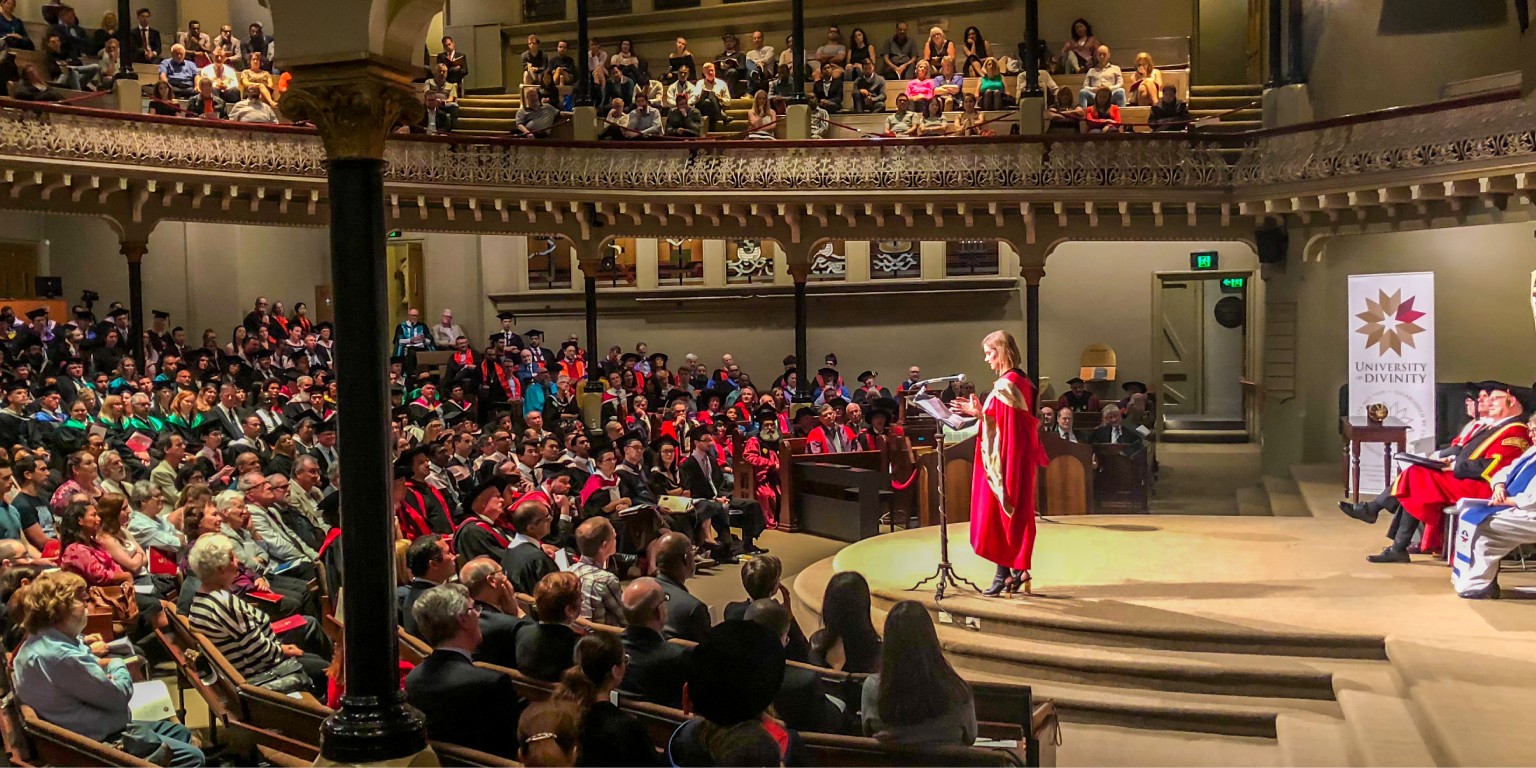

Doctor of Philosophy
What this course is about
The Doctor of Philosophy is a higher degree by research in divinity or one or more of its associated disciplines. The purpose of the Doctor of Philosophy is to qualify individuals who apply a substantial body of knowledge to research, investigate and develop new knowledge, in one or more areas of investigation, scholarship, or professional practice.
Course learning outcomes
Graduates of the Doctor of Philosophy:
- have a substantial body of knowledge at the frontier of a field of work or learning within divinity or one or more of its associated disciplines, including knowledge that constitutes an original contribution to the field
- have substantial knowledge of research principles and methods applicable to the field of work or learning
- have expert cognitive, technical and creative skills to use intellectual independence to think critically, analyze and evaluate existing knowledge and ideas, undertake a systematic investigation, reflect on theory and practice to generate original knowledge within divinity or one or more of its associated disciplines, and demonstrate expert understanding of theoretical knowledge and to reflect critically on that theory and its application
- apply knowledge and skills with intellectual independence, and with responsibility and accountability, to plan and execute an ongoing program of original research, and to understand explicit and implicit ethical considerations to the formulation of a research project
- have skills to present cogently a complex investigation of originality or original research for external examination against international standards, and to communicate research results to peers and the community.
Campus Information
Australian Lutheran College
Australian Lutheran College is a diverse learning community, committed to learning for life, providing excellence in theological education and training that prepares tomorrow's leaders in church and community.
Catholic Theological College
At Catholic Theological College our emphasis on personal reflection and pastoral service, combined with our excellence in academic rigour, enables us to offer students opportunities for deeper understanding of our faith and ways to explore how faith can contribute to our contemporary world.
Eva Burrows College
Eva Burrows College is a college for all people. Nurtured by a Wesleyan theological perspective, at Eva Burrows College we parallel quality training alongside expertise and knowledge of frontline work to equip and empower you for life, mission and service.
St Athanasius College
Our college is named after St Athanasius, the great pillar and defender of the Scriptural doctrine of Christ. St Athanasius the Apostolic (20th Pope of Alexandria) stood boldly in defence of the biblical doctrine of Christ. We follow in the footsteps of St Athanasius by pres We support local and international students as they journey towards a deeper understanding of Orthodox Christianity and spirituality, helping them grow in their faith as they prepare for diverse fields of ministry.
Morling College
Morling College is more than just a college. It is a community of men and women, staff and students from diverse backgrounds, cultures and churches dedicated to knowing God and being equipped to serve.
Pilgrim Theological College
Pilgrim Theological College is an initiative of the Uniting Church Synod of Victoria and Tasmania, providing a rich tapestry of ecumenical theological education under the leadership of a Faculty of eminent scholars.
Stirling Theological College
At Stirling we believe that the preparation of God’s people for service, leadership, ministry and mission is absolutely crucial. We are convinced that something life-giving and hope-filled happens when behaviour, belonging and belief converge.
Yarra Theological Union
Yarra Theological Union is an inclusive and welcoming community, Catholic by tradition and ecumenical in spirit. We are committed to being a community of scholarship, prayer and pastoral care.
Whitley College
Whitley College is a culturally diverse community of learners committed to practical expressions of God’s activity in the world. We wrestle together in spiritual formation through theological reflection, creative exploration and academic rigour.
Trinity College Theological School
Trinity College Theological School is committed to shaping women and men who wish to pursue ordination in the Anglican Church, develop skills for lay ministry, or simply explore Christian faith for personal or vocational enrichment.
Intakes
- Feb
- July
Application Processing Time in Days: 30
Application Process
Minimum English Language Requirements
| English Level Description | IELTS (1.0 -9.0) | TOEFL IBT (0-120) | TOEFL CBT (0-300) | PTE (10-90) | |
|---|---|---|---|---|---|
| Expert | 9 | 120 | 297-300 | 86-90 | |
| Very Good | 8.5 | 115-119 | 280-293 | 83-86 | |
| Very Good | 8 | 110-114 | 270-280 | 79-83 | |
| Good | 7.5 | 102-109 | 253-267 | 73-79 | |
| Good | 7 | 94-101 | 240-253 | 65-73 | |
| Competent | 6.5 | 79-93 | 213-233 | 58-65 | |
| Competent | 6 | 60-78 | 170-210 | 50-58 | |
| Modest | 5.5 | 46-59 | 133-210 | 43-50 | |
| Modest | 5 | 35-45 | 107-133 | 36-43 | |
| Limited | 4 | 32-34 | 97-103 | 30-36 | |
| Extremely Limited | < 4 | < 31 | < 93 | < 30 |
Job Opportunity Potential
Our graduates are highly employable, offering multidisciplinary and inter-disciplinary skills, and detailed knowledge of diverse world views and issues.
In a typical undergraduate cohort:
- 95% will be in further study or employment 6 months after graduation.
- Around 45% of our students will go on to postgraduate education, including professional qualifications such as one-year conversion courses to law, management and teaching.
- 90% of students who go directly into work will be in a managerial or professional role within 6 months of graduation
our Theology, Religion, and Philosophy of Religion (TRPR) undergraduate course once again secured its position amongst the world’s top academic programs, with a particular focus being the outstanding career prospects of our graduates recognised in multiple rankings.
PSW Opportunity
Post Study Work Steam Renames to Post Higher Education Work Steam.
- Bachelor degree holders including honours can get upto 2 years of post study stay
- Master by course work and extended (with a duration exceeding 2 years) can stay upto 2 years
- Masters by research (with a duration exceeding 2 years) and PhD holder can stay upto 3 years
- The Maximum eligible age to apply for PSW will be reduced to 35 years of age from 50 years of age for all applicants
Due to the Australian Indian Economic Cooperation and Trade Agreement signed by the 2 countries, according to which:
- Indian students completing bachelor degree including honours can stay upto 2 years
- Bachelor degree with First class honours in STEM including ICT can stay upto 3 years
- Masters by coursework in extended researched (with a duration exceeding 2 years) can stay upto 3 years
- PhD students can stay upto 4 years
Admission Requirement / Eligibility Criteria
Admission criteria
To be eligible for admission an applicant must satisfy the Research Committee that he or she has completed one of the following awards at the University of Divinity to the specified standard, or an equivalent award in divinity or its associated disciplines at another higher education provider recognized by the Academic Board to an equivalent standard:
- a Masters by research with a 75% average, or where a mark is not available, examiners’ reports which indicate to the satisfaction of the Research Committee that the candidate is adequately prepared for doctoral research; or
- a Masters by coursework with a 75% average; or
- a Graduate Diploma with a 75% average; or
- a four-year undergraduate degree with Honours with a 75% average.
An applicant must also satisfy the Research Committee that he or she has completed a research essay or thesis of at least 12,000 words graded at or above 75%. The research essay or thesis may have been completed either within one of the awards listed above or as part of another program of study.
The English language test threshold for admission to higher degrees by research at the University may be met by one of the following:
a) an IELTS Academic score of at least 7.0 with no individual band under 6.5.
b) a TOEFL Academic score of 577 with a TWE score of at least 5.0.
c) an internet-based TOEFL score of 91 with no less than 25 for Writing, 22 for Listening, 22 for Reading, 22 for Speaking.
d) a PTE Academic overall score of at least 65 and all PTE communicative skills scores of at least 58.
e) equivalent results in an English language test approved by the Academic Board.
- Course Code: 037861E
- Course Type: Full Time
- Course Level: Doctoral Degree/PhD
- Duration: 03 Year
-
Total Tuition Fee:
58824 AUD
Average Cost of Living: 29710 AUD /year
Application Fee: 300 AUD