
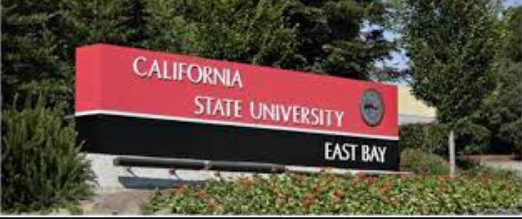

Geology, B.S.
The Department of Earth, Environmental and Sustainability Sciences offers a suite of four undergraduate majors. The Department offers undergraduate study leading to the Bachelor of Science and Bachelor of Arts degrees in Geology, focusing on developing strong foundational knowledge and a broad set of field and laboratory skills in the Earth sciences.
Geology is the study of the earth and of life and the natural processes occurring on the planet through time. Students learn about the causes of processes such as earthquakes, volcanoes, the formation of mountains, the effect of erosion and deposition, and the formation of rocks and minerals and their uses. Coursework combined with observations on field trips provide Cal State East Bay students with an understanding of natural processes and the human impact on the environment.
The Geology, B.A. program offers the student a greater degree of flexibility and may be more appropriate for those who do not plan to become certified professional geologists or pursue graduate study. (Note: Transfer from the Geology, B.A. to the Geology, B.S. program or vice versa can be accomplished.) Students wishing to do independent geological work professionally or plan on graduate study should enroll in the B.S. program; see Geology, B.S. in the Department of Earth, Environmental and Sustainability Sciences.
The B.A. program is designed to prepare students for:
Entry-level employment as geologists and environmental scientists in government (city, county, regional, state, and federal) and private consulting firms (environmental, engineering, and geotechnical firms, mining and oil companies, etc.).
K-12 Earth Science Education.
The undergraduate Geology programs emphasize field and laboratory training. Many opportunities for field and laboratory research exist throughout northern California and elsewhere. Our B.S. and B.A. program reflects departmental expertise by focusing on near-surface processes, hazards and resources, and concentrates on issues of regional and local importance to our community. Rigorous coursework is augmented by embedded and sequential field experiences that integrate classroom concepts in natural laboratories. Seminars and topical courses address diverse subjects, for example: geochemical evolution of groundwater, natural tracers of geologic processes, tectonic geomorphology, earthquake hazards, bay area tectonics, near-surface geophysics, and modern depositional environments. We maintain strong connections with East Bay Regional Parks, the California Environmental Protection Agency, Lawrence Livermore National Laboratory, NASA Ames, the U.S. Geological Survey in Menlo Park, and SLAC National Accelerator Laboratory.
The Earth & Environmental Science Club, a student-run organization, sponsors a variety of activities including guest speakers, field trips, employment workshops, and student-faculty gatherings. The club is an important part of department life, providing students with opportunities to make professional contacts, to explore graduate school and professional options, and to enjoy the company of others with similar interests.
Intakes
- Jan
- Aug
Application Processing Time in Days: 30
Minimum English Language Requirements
| English Level Description | IELTS (1.0 -9.0) | TOEFL IBT (0-120) | TOEFL CBT (0-300) | PTE (10-90) | |
|---|---|---|---|---|---|
| Expert | 9 | 120 | 297-300 | 86-90 | |
| Very Good | 8.5 | 115-119 | 280-293 | 83-86 | |
| Very Good | 8 | 110-114 | 270-280 | 79-83 | |
| Good | 7.5 | 102-109 | 253-267 | 73-79 | |
| Good | 7 | 94-101 | 240-253 | 65-73 | |
| Competent | 6.5 | 79-93 | 213-233 | 58-65 | |
| Competent | 6 | 60-78 | 170-210 | 50-58 | |
| Modest | 5.5 | 46-59 | 133-210 | 43-50 | |
| Modest | 5 | 35-45 | 107-133 | 36-43 | |
| Limited | 4 | 32-34 | 97-103 | 30-36 | |
| Extremely Limited | < 4 | < 31 | < 93 | < 30 |
Job Opportunity Potential
Cal State East Bay offers a beautiful and inspiring setting for career exploration. With three spacious campuses nestled in the East Bay — one in Hayward with spectacular views of the San Francisco Bay, one in cosmopolitan downtown Oakland and the other in the scenic Concord foothills of Mt. Diablo — you are in the heart of the cultural, technological and educational center of California.
As a faculty, staff or administrator, you will enjoy challenging and meaningful career opportunities in a wide range of disciplines along with competitive compensation, excellent benefits and potential for advancement. You will also be a part of an award-winning institution. You can be sure that as a member of one of the nation’s most diverse universities, you will benefit from the vibrant academic and cultural community whose ideas are shaping the 21st century.
PSW Opportunity
Post-Study Work visa or permit, allowing international students on F-1 visas to work in the US after completing their studies, typically through Optional Practical Training (OPT).
Eligibility:
To be eligible for OPT, students must have been enrolled full-time in a US educational institution for at least one academic year and be seeking work related to their major.
Duration:
Students can apply for up to 12 months of OPT, either before they finish their studies (pre-completion) or after graduation (post-completion).
STEM OPT:
Students in STEM (Science, Technology, Engineering, and Mathematics) fields can apply for an extended OPT period of up to 24 months.
Contact our PSA counselor for more information
Admission Requirement / Eligibility Criteria
All graduate and post-baccalaureate applicants, regardless of citizenship, whose native language is not English and whose preparatory education was principally in a language other than English must demonstrate competence in English. Those who do not possess a bachelor’s degree from a postsecondary institution where English is the principal language of instruction must receive a minimum score of 80 on the Internet-based or 550 on the paper-based Test of English as a Foreign Language (TOEFL). Some programs require a higher score. Several CSU campuses may use alternative methods for assessing fluency in English including Pearson Test of English Academic (PTE Academic), the International English Language Testing System (IELTS) and the International Test of English Proficiency (ITEP).
Cal State East Bay interprets “where English was the principal language of instruction” to mean that a school is located in a country where English is the native language (the daily medium of communication of the majority of residents is English), and that the students receive academic instruction in all subjects (except foreign language courses) at all levels of education in English. Therefore, letters or transcripts attesting to English as the principal medium of instruction from institutions in countries where English is not the official language, will not be accepted.
Countries currently meeting the above requirement are: Anguilla, Antigua and Barbuda, Australia, Bahamas, Barbados, Belize (formerly British Honduras), Bermuda, Botswana, Canada (except Newfoundland, Nova Scotia & Quebec), Cayman Islands, Commonwealth Caribbean, Dominica, England, Fiji, Gambia, Ghana, Grenada, Guyana (aka British Guiana), Ireland, Jamaica, Kiribati, Lesotho, Liberia, Micronesia, Montserrat, Namibia, New Zealand, Saint Helena, Saint Lucia (Caribbean Commonwealth), Scotland, Sierra Leone, South Africa, Trinidad & Tobago, United Kingdom, Virgin Islands (British), Wales, Zambia and Zimbabwe.
Applicants may fulfill the English language requirement by submitting:
An official transcript showing graduation with a bachelor’s degree from a U.S. college or university, or an international college or university in a country where English is the official language (as given in the list above.)
A TOEFL (Test of English as a Foreign Language) score of 550 (213 computer-based or 80 Internet-based) or above. A score of 92 (Internet-based) or above is required for applicants seeking a Master’s of Science degree in Economics).
An overall test score on the IELTS (International English Language Testing System) exam of 6.5 or above. A score of 7 or above is required for applicants seeking a Master’s of Science degree in Economics.
- Course Type: Full Time
- Course Level: Bachelors/UG Degree
- Duration: 04 Year
-
Total Tuition Fee:
74420 USD
Average Cost of Living: 14000 USD /year
Application Fee: 70 USD
Similar Programs
- Statistics, M.S.: Applied Statistics Concentration at California State University, East Bay
- Statistics, B.S. at California State University, East Bay
- Recreation, B.S.: Youth Development Programming Concentration at California State University, East Bay
- Recreation, B.S.: Sustainability Concentration at California State University, East Bay
- Recreation, B.S.: Recreation Therapy Concentration at California State University, East Bay
- Recreation, B.S. at California State University, East Bay